
Why Permanent Settlement still makes little Sense
Main Article
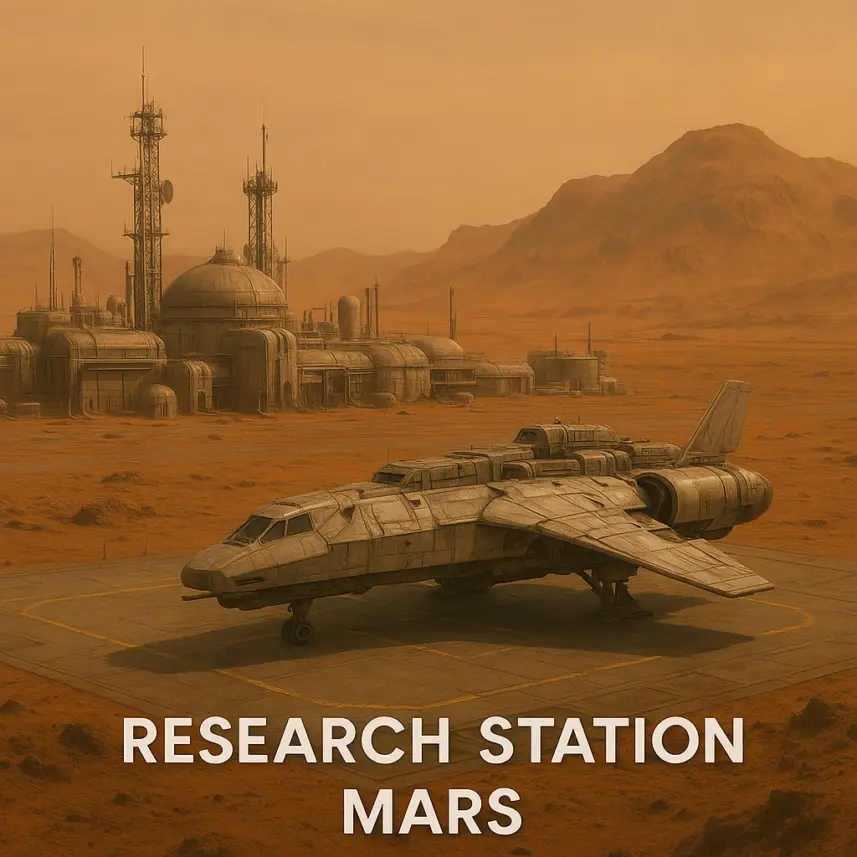
Mars Colonies: Why Permanent Settlement Still Makes Little Sense
Mars has
become more than a destination for science. It is increasingly presented as
humanity’s next home: a world where settlers will build cities, produce their
own resources and establish a second civilisation. The
physical reality is far less forgiving. Radiation, isolation, difficult
landings, limited rescue options, toxic dust, fragile life-support systems and
the enormous complexity of returning to Earth make permanent settlement a
questionable objective. A crewed
scientific expedition to Mars could deliver important knowledge. Colonisation
is a very different proposition.
The
journey begins with radiation
Earth’s
magnetic field protects life from much of the radiation found in interplanetary
space. A crew travelling to Mars would leave that protection behind. During
the Mars Science Laboratory’s journey, Curiosity’s Radiation Assessment
Detector measured an average galactic cosmic-ray exposure of approximately 1.8
millisieverts per day inside the spacecraft. The figure cannot simply be
transferred to a future crew vehicle, but it demonstrates the scale of the
problem. NASA/JPL:
Radiation Data from the Voyage to Mars. Using
measurements gathered during the flight and on the surface, researchers
estimated that a representative return mission under similar solar conditions
could expose astronauts to a total dose in the region of 1,000 millisieverts.
Solar particle events add further uncertainty. NASA:
Radiation Measurements and Human Exploration Additional
shielding increases spacecraft mass. Greater mass demands more launch capacity,
energy and propellant. Radiation is therefore both a medical hazard and a
fundamental engineering constraint.
Landing
a human-scale vehicle has never been demonstrated
Mars has
enough atmosphere to generate heat and aerodynamic stress, but not enough to
slow a large vehicle with parachutes alone. Human missions would need to land
many tonnes of habitats, power systems, supplies, vehicles and return
equipment. NASA
continues to develop supersonic retropropulsion and related technologies for
high-mass Mars landings. No human-rated atmospheric landing system of this kind
has yet operated on Mars. NASA:
Propulsive Descent Technologies. It would
be misleading to assign a numerical probability of survival before a specific
spacecraft and mission design exist. What can be said is that landing a crew
and its infrastructure remains one of the central unresolved challenges.
Earth
cannot provide immediate help
A
one-way communication delay of up to approximately 20 minutes prevents
real-time conversation with mission control. Medical emergencies, equipment
failures and habitat damage would have to be managed locally. NASA: Hazard –
Distance From Earth. Physical
rescue would be far more difficult. Efficient launch opportunities between
Earth and Mars occur only about every 26 months, followed by a journey lasting
many months. NASA:
Mars Launch Opportunities . A failed
oxygen generator, damaged pressure vessel or serious illness could not be
answered by dispatching help from Earth. Any settlement would need extensive
redundancy, local medical capability and crews trained to operate without
direct assistance. Mars
would not be a distant research station. It would be an isolated world.
The
return journey is possible, but it must be built in advance
Mars
does not make a return impossible simply because ready-made rocket fuel is
absent. NASA is studying ascent vehicles that could arrive fully fuelled,
receive propellant from a pre-positioned depot or use resources produced on
Mars. NASA:
Getting Back from Mars. Every
option adds mass and complexity. A Mars ascent vehicle would first have to
carry the crew from the surface into orbit. The astronauts would then need to
rendezvous with another spacecraft capable of supporting them during the long
return to Earth. A
responsible mission would deliver, fuel and verify this system before the crew
left Earth. Without a proven return architecture, the expedition would indeed
become a one-way journey. A lack
of propellant is not an unavoidable law of nature. It would be the result of an
incomplete mission design or a deliberate decision to abandon the possibility
of return.
Mars
has water, but not a convenient water supply
Orbital
surveys have identified substantial deposits of subsurface water ice. Some may
lie relatively close to the surface and could provide drinking water, oxygen
and feedstock for propellant production. NASA:
SWIM Map of Subsurface Water Ice. Accessing
that resource would still require mining equipment, power, purification
systems, storage and highly efficient recycling. The settlement would also have
to be built close enough to suitable ice without choosing a landing site that
is too cold, too high or otherwise unsafe. Martian
soil and ice may contain hazardous perchlorates. These compounds would need to
be removed before water could be used safely for drinking, agriculture or
industrial processes. NASA:
Detoxifying Mars. Water on
Mars is a potential resource, not a functioning utility.
Much
of life would take place behind shielding
Mars
lacks a global protective magnetosphere and its thin atmosphere provides only
limited radiation shielding. Long-term habitats could be placed below ground or
covered with thick layers of regolith and water-rich materials.
Research
supported by the European Space Agency is examining how locally sourced clay,
ice and brines might be used to create structures with improved radiation
protection. ESA:
Sustainable Radiation Shielding on Mars
Future
settlers would probably spend much of their lives in sealed, heavily shielded
environments with limited access to natural light. The popular image of
transparent domes overlooking the Martian landscape has little connection with
the requirements of radiation protection.
Terraforming
remains beyond present-day technology
Mars
does possess an atmosphere, but its surface pressure is less than one per cent
of Earth’s. It is too thin and cold to support stable liquid water in the open. A
NASA-supported study concluded that Mars does not contain enough accessible
carbon dioxide to thicken and warm the atmosphere sufficiently using
present-day technology. Much of its earlier atmosphere has already been lost to
space. NASA:
Mars Terraforming Not Possible Using Present-Day Technology. Terraforming
is therefore not prevented by a complete absence of atmosphere. It is prevented
by its extremely low pressure, the shortage of accessible greenhouse gases and
the vast energy required to alter an entire planet. Any
foreseeable settlement would remain dependent upon sealed habitats and
mechanical life support.
The
cost cannot yet be calculated honestly
There is
no complete, funded architecture for a crewed Mars landing, let alone a
self-sufficient settlement. NASA’s current Moon to Mars Architecture remains
evolutionary, with major decisions concerning landing systems, ascent vehicles,
habitats, power and local resource use still under study. NASA: Moon to Mars
Architecture A
credible settlement would require repeated launches over many years, extensive
redundancy and an interplanetary supply network. Any confident total price
presented today would be speculation. The
required infrastructure would include transport spacecraft, cargo landers,
power generation, radiation shielding, water extraction, food production,
medical facilities, spare parts, communications satellites and a complete
return system.
Scientific
value does not automatically justify colonisation
Mars is
scientifically important. It may contain evidence of ancient microbial life and
can help researchers understand planetary climate, atmospheric loss and the
development of potentially habitable worlds. NASA: Humans to
Mars
Human
explorers could make rapid decisions and carry out complex fieldwork. Robots,
however, can operate for years without air, food or protection from many of the
hazards that threaten a crew. The
scientifically honest question is not whether Mars deserves exploration. It is
whether permanent settlement offers enough additional value to justify its cost
and human risk. Limited
expeditions may eventually provide a defensible answer. A colony is a much
larger claim.
Conclusion:
a destination for science, not a replacement Earth
A crewed
journey to Mars could become one of humanity’s greatest engineering
achievements. It might answer important scientific questions and drive
technological innovation. A
permanent colony is another matter. Radiation, isolation, difficult landings,
uncertain local resources, complex return systems and incalculable costs make
settlement difficult to justify with foreseeable technology.
Mars may
become a destination for carefully planned scientific expeditions. It is not a
practical refuge, a second Earth or an easy new beginning. Before
attempting to make another planet habitable, humanity should demonstrate that
it can preserve the habitable world it already possesses.