Sf-Short Storys
in Progress
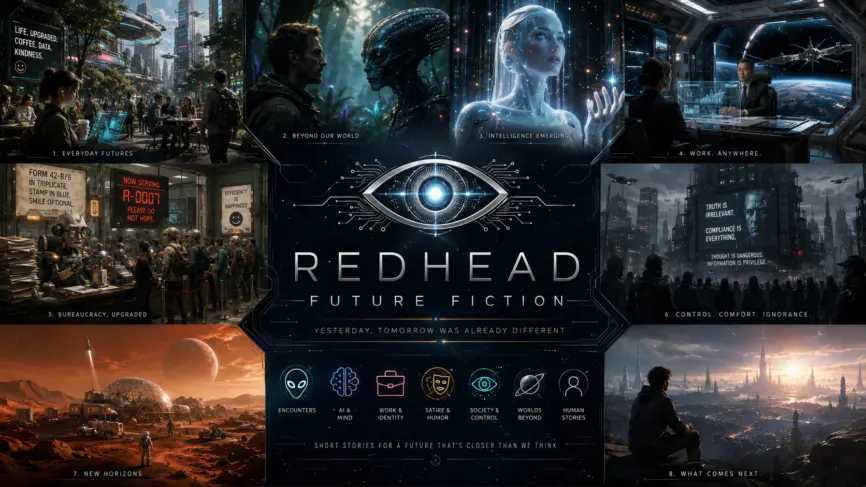
YESTERDAY, TOMORROW WAS ALREADY DIFFERENT
Overview of the Science Fiction Short Story Series by Barry Redhead
With “Yesterday, Tomorrow Was Already Different,” Barry Redhead creates a science fiction short story series that deliberately moves beyond the familiar paths of the genre. This is not science fiction built only around space battles, distant empires, or technological wonders. Instead, the series explores something the genre has rarely examined with such consistency: the everyday life of the future.
These stories follow people living in worlds that are changing faster than they can understand. They tell of alien encounters that are not merely presented as spectacle, but as cultural, emotional, and social shocks. They explore artificial intelligence not simply as a technical invention, but as a force that reshapes decisions, careers, relationships, guilt, morality, and human identity. They look at job searches, professional life, and future working environments — at occupations that may seem absurd today but could become normal tomorrow.
But these stories are not only dystopian. “Yesterday, Tomorrow Was Already Different” combines dark visions of the future with humor, satire, and sharp social criticism. Barry Redhead uses the tools of science fiction to examine the world we live in today: human ignorance, political short-sightedness, technological arrogance, media superficiality, bureaucratic absurdity, and the dangerous comfort of a society that often recognizes warning signs only after they have already become disasters.
This is where the particular power of the series lies: it presents the future not merely as catastrophe, but also as a grotesque mirror of the present. Some stories are serious, melancholic, or philosophical. Others work through biting humor, absurd situations, and satirical exaggeration. Others again speak of hope, otherness, compassion, and the question of whether humanity, despite all its failures, is still capable of learning. The ordinary world of human beings — everyday life between technology, existential pressure, humor, bureaucracy, hope, and overload — has rarely been portrayed in futuristic science fiction with this level of focus.
Barry Redhead places exactly this at the center of his series. He does not only examine the grand questions of civilization, but also its small, often overlooked moments: the job interview in orbit, the ethical decision of a machine, the absurd logic of future authorities, the loneliness of highly technological cities, contact with alien life forms, and the encounter with the unknown in the form of everyday reality.
“Yesterday, Tomorrow Was Already Different” combines classic science fiction ideas with modern social observation. The stories move between AI dilemmas, alien contact, work and identity, space travel, consciousness, future satire, social criticism, and one existential question: What remains of humanity when the world is no longer made for human beings?
Barry Redhead writes science fiction with cinematic visual power, journalistic sharpness, and literary ambition. His stories do not only look toward distant futures; they reflect directly back on the present. They ask where technology, politics, work, media, and artificial intelligence may lead humanity — and whether human beings will still remain the protagonists of that future or have already become a footnote in the world of their own creations. As an author with Experience as Hollywood Director, Barry Redhead combines visionary images of the future with a precise sense of social rupture. His science fiction is not merely an escape into other worlds, but a mirror held up to our own. It tells of aliens, machines, and stars — but at its core, it is always about humanity.
“Yesterday, Tomorrow Was Already Different” is therefore an exceptional science fiction series about the future, everyday life, consciousness, and civilization. A series for readers who do not only want to know what tomorrow’s world may look like, but also what it will feel like to live in it — and which mistakes of the present may already have become reality there.