
A SF_Short by Barry Redhead
Sf Shorts
Cydonia’s Last Breath
Arrival in the Blood-Red Dust
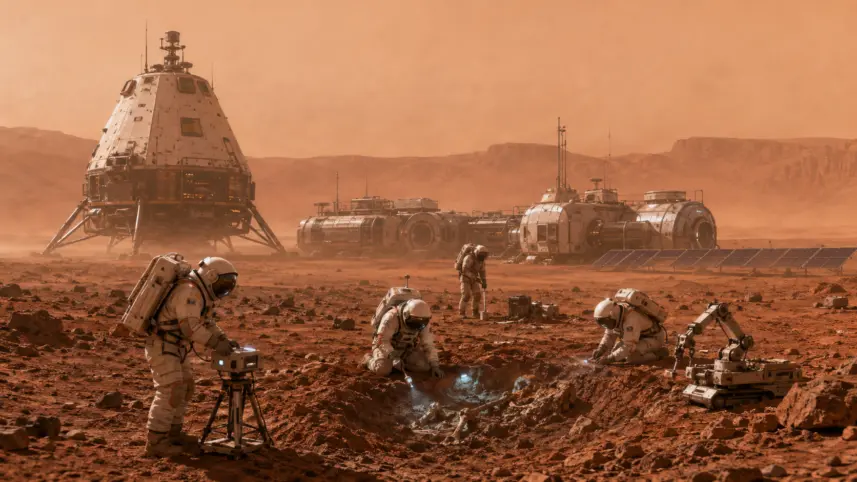
Mars offered no welcome; it was a cold, dry threat made of iron oxide. When the Vanguard-7 lander touched down in southeastern Acidalia Planitia, not far from Cydonia Colles, a cloud of ochre-coloured dust billowed around it. To Kenji Sato, it felt less like a triumph than stepping into a vast, unsealed tomb. The distant howl of the wind against the lander’s titanium hull sounded like the sobbing of a world that had forgotten how to breathe aeons ago.
“Landing struts stable. Pressure equalisation initiated in Sector Four,” reported Alistair Thorne, the British commander. Even now, his voice retained the habitual, glacial calm of a man who regarded death in space as a purely logistical problem.
The crew consisted of seven specialists, a disparate company driven by humanity’s urge to explore the unknown: Kenji from Japan, Alistair from England, the Latvian chief engineer Elīza Kalniņa, the Ukrainian geologist Mykola Fedorov, the French exobiologist Dr Claire Beaumont, the German archaeotechnician Lukas Weber and the Canadian systems analyst Sarah Miller. Their destination was the Alpha-Core base station, a modular complex that had landed autonomously several months earlier.
As the hatch slid open and the seven astronauts stepped onto the Martian surface in their heavy, nanoceramic-coated exoskeletons, the silence was absolute. Only the rhythmic hiss of their recycler units accompanied them. They looked towards the base, crouching like a white insect in the rust-coloured expanse. Yet as they connected the Vanguard’s first supply cables to the station, they had no inkling that the true treasure – and the true horror – lay waiting directly beneath their boots.
The Whisper Beneath
Three days after landing, excavation began on the underground radiation shelters. Mykola operated the remote-controlled heavy excavator Mole-R, its diamond-tipped cutters screeching through the permafrost and hard rock.
“There’s something here,” Mykola said suddenly over the radio. His tone was no longer professional; it was brittle. “Lukas, bring the ground-penetrating radar over here. This isn’t granite.”
Lukas Weber stepped to the edge of the excavation pit. His scanner was a marvel of radar tomography, sending broadband pulses into the rock and constructing a three-dimensional image of the ground beneath them in real time. When the hologram flickered onto his wrist-mounted display, he froze.
“Alistair, Claire… you won’t believe this,” Lukas whispered. “They aren’t geological inclusions. They’re mineralised structures.”
Two metres below the surface, embedded in red sand that had lain undisturbed for hundreds of millions of years, were bones. It was no isolated discovery. Beneath them stretched an entire field of skeletons that, at first glance, appeared disturbingly humanoid. They lay entwined at unnatural angles. Claire Beaumont knelt in the dust and brushed the red dirt from a skull with the practised precision of an experienced field scientist.
“That’s impossible,” she murmured. “The stratigraphy… this site is between 500 and 900 million years old. Even at the younger end of that range, complex life on Earth was still confined to the oceans.”
The skull was elongated, the eye sockets enormous, the jaw narrow. There were no signs of tooth decay, but the wear on the teeth suggested a coarse, unprocessed diet. It was the skeleton of a creature that physically resembled a human. For now, no one could say how far its culture had developed – or whether it had possessed one at all.
The Cathedral of Oblivion
The excavations were extended, leading the crew deeper underground. There they encountered a natural cave system spreading beneath the landing site. Sheltered from cosmic radiation and the dust storms of the surface, it presented them with a sight that shattered their understanding of biology.
In the vast chambers, they found the remains of animals. Gigantic six-legged creatures with chitinous carapaces leaned against the walls like fossilised nightmares. Others possessed wing-like membranes, suggesting that the Martian atmosphere had once been dense enough to support vast aerial creatures. Nothing about them resembled terrestrial fauna. This was a completely independent line of evolution, a lost blueprint of life.
“Look at this,” Sarah Miller said, shining her high-powered torch into a recess.
Three of the humanoids were crouched there, clinging to one another. There were no tools among them, no worked stone, no jewellery. Only the raw, broken bones of their prey.
“They apparently knew nothing of fire,” Claire said as she examined the cave walls.
She moved the beam slowly across the rock.
“No soot. No burn marks. At least not in this refuge. They were completely adapted to this world – until the world decided to kill them.”
Elīza Kalniņa examined the seal at the cave entrance. It was a poignant, desperate construction: mud mixed with crushed plant fibres that had turned to stone over millions of years. The humanoids had tried to seal the cave from the inside. They had tried to hold on to the dying atmosphere, pressing it into the rock with their bare hands.
“They didn’t run out of water,” Elīza said quietly. “Gas bubbles trapped in the mineral layers and the isotope ratios indicate a rapid decline in available oxygen. The solar wind must have thinned the atmosphere until the pressure collapsed.”
She looked at the three figures in the recess.
“If we’re reading the evidence correctly, they suffocated. In the darkness, in the cold, without light, without hope. They held on to one another whilst their world took the air from them.”
The Bitter Legacy
In the weeks that followed, the Mars mission changed from a scientific expedition into a forensic examination of a planet’s death. Mykola found evidence of something that every accepted model declared impossible: the late, abrupt collapse of a previously unknown second magnetic cycle. The discovery contradicted everything humanity believed it knew about the history of Mars. A period of extreme solar activity appeared to have finished the process, thinning the atmosphere to lethal levels within a few thousand years.In the base’s infirmary, Kenji Sato studied one of the recovered femurs. It was completely mineralised yet preserved in such exquisite detail that its surface appeared almost fresh. The cold, the aridity and the mineral-rich sediment had preserved the dead like exhibits in a display case of infinity.
“We came here to find a new home,” Kenji said that evening as the seven astronauts sat in the common room, gazing through the reinforced viewing window at the barren, deadly landscape. “We thought Mars was a blank canvas. A chance for a new beginning.”
Alistair Thorne stirred his synthetic tea.
“We’re not the first to have thought that. These beings… they lived here for millions of years. Successfully, in their own way. And they were wiped out without the universe so much as batting an eyelid.”
Outside, a dust storm raged and erased the horizon. Output from the solar arrays fell as electrostatically charged dust worked its way into every exposed seal. On the screens, the radar maps of the caves flickered, now revealing the chambers for what they truly were: the final refuge of a failed world. The realisation slowly settled into their minds, heavier than anything they had brought to Mars. They watched the skeletons on their monitors, the silent witnesses to a catastrophe against which their world had left them no defence.
Mars was not a second beginning.
It was a memorial.
Earth, with all its flaws, wars and dwindling biodiversity, was a fragile jewel in an ocean of black poison. Mars had never been a refuge. It was merely a reminder of what happens when a world loses the conditions that keep it alive.
Humanity could build colonies, erect domes and force oxygen from the soil. But here, it would always remain an intruder in a mortuary.
The bones in the dust whispered a truth that no one wanted to hear: if we lose our home, there is nowhere we can go that truly wants us.
Mars belonged to the dead.
And the vacuum waited patiently for the next species foolish enough to believe it could escape the fate of a planet.
END