
The old one and the new One
Movie Tip
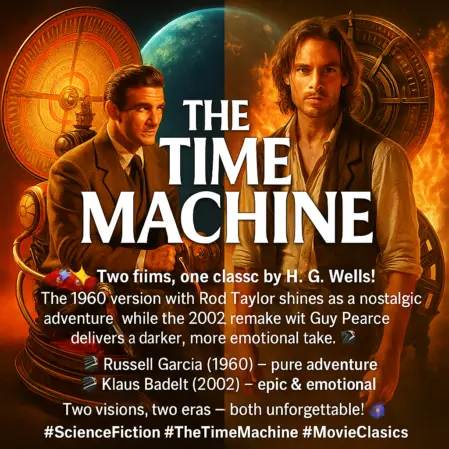
The Timemachine
The 1960 film by George Pal is considered one of the most significant science fiction classics today. The story follows the scientist George (Rod Taylor), who tells his friends about his invention on New Year's Eve 1899. He travels into the future, experiences world wars, and ultimately the atomic destruction of civilization in 1966. Finally, he lands in the year 802,701. There he meets the Eloi – a gentle but completely apathetic community – and their dark counterparts, the subterranean Morlocks, who keep the Eloi like livestock.
Directed by Simon Wells, the great-grandfather of the book's author, the story received a modern update. Here, the protagonist Alexander Hartdegen (Guy Pearce) is driven not just by scientific curiosity, but by personal trauma: he wants to undo the death of his fiancée. Since the past seems unchangeable, he travels to the future to find answers. Due to a catastrophe on the moon, he is also catapulted into the year 802,701.
Key Differences
While both films are based on the same premise, they differ in motivation and worldview:
- The Motivation: In the 1960 version, George is a classic Victorian explorer aiming to advance humanity through knowledge. In 2002, Alexander is a broken man fleeing his pain, finding a new purpose only after meeting the Eloi.
- The Society: The original reflects Cold War fears (sirens, atomic bunker instincts). The remake focuses more on ecological and technological hubris (the destruction of the moon through mining).
- The Morlocks: In 1960, they were hairy, blue-skinned monsters with glowing eyes – handmade horror. In 2002, thanks to CGI and makeup, they are more agile, threatening, and led by an "Uber-Morlock" (Jeremy Irons) who interacts intellectually with the time traveler.
The Heroes and Their Performance
Rod Taylor (1960): Taylor plays the hero with a mix of Victorian etiquette and physical presence. He is the "doer" who fights with fists and intellect for the freedom of the Eloi. His George radiates optimism and moral integrity – a classic hero of Hollywood's Golden Age. Guy Pearce (2002): Pearce delivers a significantly more nervous and vulnerable performance. His Alexander is an eccentric intellectual who only matures into a reluctant hero throughout the film. He appears more modern, tormented, and less certain in his role as a saviour, making him more relatable to a contemporary audience.
Qualitative Judgment & Audience Acceptance
- 1960 Version: It enjoys absolute cult status. The Oscar-winning special effects (like the time-lapse growing of flowers) have a magical quality that still inspires today. Audiences love the nostalgic charm and the clear moral message.
- 2002 Version: This film polarizes opinions. While the visual effects and set design (especially the time machine itself) are praised, many fans criticized the deviations from the original's philosophical depth in favor of action scenes in the final third. Nevertheless, it is often appreciated today as an underrated adventure film of the early 2000s.
Summary and Recommendation
Are both films worth watching? A clear yes!
The 1960 original is a must-see for any cinephile. It is a perfectly aged fairy tale about human nature. The 2002 remake, on the other hand, offers a visually stunning spectacle with a great soundtrack by Klaus Badelt and a charismatic villain.
Recommendation: Watch the original first to understand the roots of the genre and use the remake as an exciting "what-if" expansion with modern visual appeal.