
The Last Image of Home
Short SF-Stories
The Last Image of Home
I. The Silence of the Frequencies
Commander Samuel Aristharkos stared at the oscilloscope, its green line as flat as the barren plains of Chryse Planitia outside the protective domes. It wasn't a technical failure. The antennas were perfectly aligned, and the relay satellites in orbit were functioning flawlessly. The problem was the source. Earth was silent.
"Nothing, Sam?" asked Dr. Elena Vance. She was the lead exo-biologist of the Ares-Prime colony and one of the few who still found the strength to visit the control room.
Aristharkos shook his head. "No carrier signal from Houston. No broadband data from Brussels. Even the automated NOAA weather probes have gone quiet."
No supply ship had landed in eight weeks. The last vessel, the Vasco da Gama, had departed hectically in February 2067. The crew had brought grim news: the conflict over Taiwan had escalated. China had moved in earnest. The USA, riddled by internal unrest and economic decay, had been barely functional. Europe had attempted to build a defensive line with the remnants of NATO—Japan, Australia, and a battle-hardened Ukraine. That was the last they knew. Then came the silence.
II. The Mathematics of Hunger
In the mess hall, people sat in silence. Only 231 souls remained on Mars. Engineers, botanists, geologists. Men and women who had come to build a new world, only to find themselves stranded on an island in the middle of nowhere.
"We have supplies for two, maybe three months," said Kaito Tanaka, the logistics officer, during a crisis meeting of the five senior staff members. "If we reduce caloric intake to the absolute minimum—pushing ourselves to the brink of being unable to work—we might gain another four weeks. But without fresh seeds and without spare parts for the hydroponic filters, we will starve. Slowly."
"And the rescue ship?" Vance asked.
"The Icarus?" Tanaka laughed dryly. "She barely has enough fuel to reach orbit. A return flight to Earth requires calculations and acceleration phases for which we no longer have the chemistry. We are here. And we are staying here." Aristharkos rubbed his eyes. He thought of the old Hubble Telescope. It was a relic from the early 21st century, long since replaced by James Webb and its successors, but it still circled out there, forgotten in the void. It had been built to explore distant galaxies, but its mirrors could also be reversed.
"We need certainty," Aristharkos said. "I’m going to try to hack the Hubble relay. It’s old enough that our emergency codes might still work. We need to see what happened down there."
III. A Gaze into the Abyss
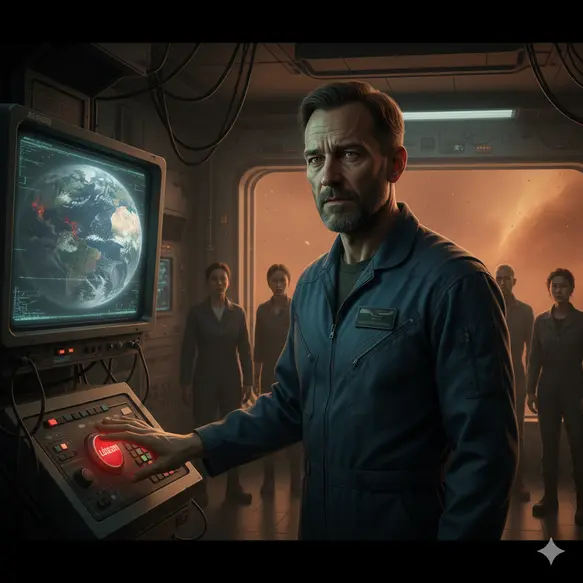
It took three days to reactivate the old protocols. The crew worked mechanically. No one spoke of the fear. The station’s surroundings suddenly felt more hostile than ever before. The red dust lashing against the reinforced windows was no longer just a geological fact—it was a shroud. Finally, the monitor flickered to life. The connection to the Hubble Telescope was established.
"I'm aligning the mirror," Aristharkos whispered. His heart beat against his ribs like a trapped bird. "Focusing on the Northern Hemisphere. Coordinates Western Europe... East Asia."
Elena Vance stepped behind him. Kaito Tanaka and two other technicians held their breath. The image took minutes to build, line by line. The delay was the cruelest torture physics could inflict. At first, they saw the blue. But it wasn't the brilliant sapphire blue they knew from the photos of their childhood. It was a dirty, murky gray-blue.
"Clouds?" Vance asked hopefully.
"No," Aristharkos said, his voice thick. "Ash. And soot."
He zoomed in further. Where the strings of lights from Paris, London, and Berlin had once marked the night side of the planet, there was now utter, unnatural darkness. There were no more artificial lights. No cities. Only glowing scars stretching across continents—the afterglow of nuclear fires that had turned entire regions into slag. They panned the camera east. The coastlines of China and Taiwan were buried under a massive black blanket. Earth's atmosphere had collapsed, saturated with the dust of a billion incinerated lives.
"Nothing lives down there anymore," Tanaka whispered. It wasn't speculation. It was a mathematical certainty speaking from the spectral data. Methane and CO2 levels had spiked. Earth was no longer a blue dot. It was a grave.
IV. The Dilemma of Truth
The silence in the control room was heavier than the gravity of Jupiter. Five people stared at the monitor, where their entire history, their families, their hopes, and their origins had been suffocated in a gray haze.
"We can't tell them," Vance said suddenly. Her voice trembled.
"We must," Tanaka countered. "They have a right to know why no ship is coming."
"And then what?" Vance almost screamed. "We have 226 people out there who believe there is a chance. If we show them this, we take away the last two months of their lives. We turn their hope into a long, agonizing suicide. Do you want them to panic? To waste the remaining resources in days because it doesn't matter anyway?"
Aristharkos looked at the display of the life-support probes. 231 people. Asimovian calculus began to work in his mind. The good of the many. But what was the good of the many when the end was certain? Was it the truth that led to despair, or the lie that enabled a peaceful, if meaningless, death?
"If we hide it," Aristharkos said slowly, "they will work until the very last day. They will try to save the hydroponics. They will eat together; they will tell stories of returning home. They will die... as humans."
"And if we tell them?" Tanaka asked.
"Then they die like animals trapped in a cage," Aristharkos replied.
V. The Final Decision
He deleted the image. The data was buried deep within the protected core of the onboard computer, locked with a command code that only he possessed.
"Commander?" asked the young radio technician at the door, just arriving for his shift. "Were you able to receive anything through the Hubble Telescope? Do we know when the supplies are coming?" Aristharkos looked at his four companions. He saw the horror in their eyes, which now had to be hidden behind a mask of cold duty.
"The atmospheric interference from the war is stronger than expected," Aristharkos said with a steady voice. "The telescope couldn't provide clear images. But calculations show the radio silence might last for several more weeks. We must tighten rationing to bridge the gap."
The young technician nodded, disappointed but composed. "Understood, Sir. We'll make it." As the technician left, Aristharkos turned back to the empty monitor. He knew he had just signed the death warrant for humanity—not by the act itself, but by the silence. They were 231 people on a cold, red stone. They were the last witnesses to a dying universe. And for the next 90 days, they would live the only lie the universe had left to offer: the hope for a tomorrow that would never come.
Mission:
Artifact 1: The Official Mission Log (Public)
This is what the 226 colonists see on the internal network.
LOG ENTRY: MISSION ARES-PRIME SOL: 2482 STATUS: CRITICAL RATIONING PHASE 4 AUTHOR: Commander S. Aristharkos
Summary: Atmospheric disturbances on Earth caused by the escalation of the Southeast Asian conflict have reached a peak. High-altitude particulate matter has rendered the Hubble-Relay visualization inconclusive. We expect communication blackouts to continue for an indefinite period.
Instruction: Effective immediately, all personnel are restricted to 1,200 calories per day. Energy priority is shifted to Hydroponics Wing B. We remain in "Self-Sustaining Mode." Our duty is to the station. We wait. We endure.
THE END