


The Wasteland of the Bipeds
Short SF-Stories

The Wasteland of the Bipeds
I. A Monolithic Foreign Body
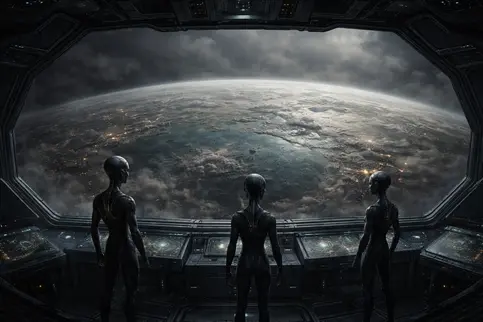
The starship Xylanthrop was not a ship in the human sense. It was a crystalline structure, a fractal of living silicon and shimmering plasma that had draped itself across the Earth’s equator like a gigantic, frozen flame. Within its interior, no noise of machinery pulsed; instead, there was a rhythmic, electrostatic hum, he heartbeat of a civilization that had long since transcended the concept of time. On the bridge, a vaulted space made of liquid light, stood the three observers of the vanguard. They were humanoids, yet their evolution had chosen different paths. Their skin was the color of quicksilver, smooth and poreless, and their eyes were faceted prisms that perceived the entire electromagnetic spectrum. They wore no clothing, but rather fine webs of gravitational energy that enveloped their slender, sinewy bodies.
"The biosphere is a single, continuous sob," said Vax, the First Analyst. His voice was not transmitted via sound waves but through direct neural induction.
"I see the dying in the oceans. It is not a clean death. It is a suffocation in their own filth."
II. The Gaze Through the Prism
The bridge of the Xylanthrop offered a view that would have driven any human to madness. The aliens did not view the Earth as continents and nations, but as a complex web of chemical signatures and heat flows. Vax pointed toward a data cloud hovering over the Northern Hemisphere.
"The bipeds. The dominant species, as they call themselves in their hubris. They discovered fire, but they never learned how to extinguish it. The atmosphere is saturated with carbon and sulfur. They breathe their own decay."
"They are fascinating in their limitation," added Kael, the specialist in sociogenetics. Her head tilted at an unnatural angle.
"They wage wars over lines they have drawn in the mud. They hoard warheads as if they were religious relics. Their intelligence is a malfunction of evolution, a sharp mind trapped within an aggressive primate brain."
III. The Dilemma of the Bridge
A vibration arose on the bridge—a sensation that, among their kind, constituted an argument.
"We should land now," demanded Zenon, the commander of the military faction. He was more powerfully built, his quicksilver skin shimmering in an aggressive violet.
"The resources in the mantle are stable. We displace the bipeds, cleanse the atmosphere with our particle filters, and begin the seeding. We lost our place on Kryon-4. We need this rock."
Kael shook her head, an action like the sparkle of a cut diamond.
"An invasion is a waste of energy, Zenon. Look at the data. The species Homo Sapiens is in the final phase of entropy. In less than five hundred standard years, their birth rate will fall below the death rate, accelerated by their own toxins and their inability for global cooperation. Why should we send our soldiers into a war with unstable lunatics?"
"They are bellicose," Vax agreed. "If we land now, they will attempt to bombard our hull with their primitive nuclear fission weapons. It would not destroy us, but it would poison the planet even further. It would be like trying to occupy a house by inciting the landlord to set it on fire."
IV. The Feelings of the Besieged
Deep beneath them, in the urban canyons of New York, Berlin, and Shanghai, an atmosphere of collective psychosis reigned. The arrival of the Xylanthrop had shredded the last remnants of social order. People stared into the sky. Some prayed, others fired rifles into the void, while others sat apathetically in their polluted apartments, waiting for the blow that never came. It was a mixture of religious ecstasy and animal terror. The starship had plunged the sky into a permanent, uncanny twilight. On news channels, politicians and generals argued over retaliatory strikes, while scientists desperately noted that none of their probes could so much as touch the crystalline hull. They felt small. For the first time in their history, humans did not feel like the masters of creation, but like ants beneath a hovering boot. A boot that neither descended nor withdrew.
V. The Logic of Waiting
"The planet needs time," Kael said, projecting a simulation onto the bridge wall.
"Look at the recovery rates. Without the industrial burden of the humans, the oxygen levels will return to Holocene levels in six centuries. The forests will swallow the ruins. The radiation will subside."
Zenon gazed down at the flickering cities of Earth, glowing like ulcers in the dark. "So you want to wait? While our people sleep in the cryo-tanks of the fleet?"
"It is the only efficient solution," Vax replied coolly. "Invasion means chaos. Patience means harvest. When we return in five hundred years, this species will be nothing more than a layer in the geological sediment. We will not have to conquer the Earth. We will simply take it over when it is empty. A purified paradise, freed from the noise and the filth of the bipeds."
VI. Departure into Silence
The decision was reached through the consensus of logic. The violet shimmer in Zenon’s skin faded to a resigned silver-gray.
The Xylanthrop began to rotate. The gravitational waves caused the oceans beneath them to shudder, triggering devastating tsunamis on Earth, an unintended side effect of their departure that the aliens barely acknowledged.
"Let us leave them to their games," said the Commander.
"Let them fight their little wars and breathe their dirty air until the last light of their civilization flickers out."
The starship accelerated. In the eyes of the aliens, Earth was no longer a target, but a project for later review. A dirty jewel that had to lie in the mud before it could shine again.
As the crystalline vessel left Earth’s orbit and vanished as a twinkling star in the night sky, the people down in the ruins cheered. They believed they had driven the enemy away. They celebrated their perceived victory with renewed pride, restarting their factories and reloading their weapons. They did not suspect that their disappearance was already a settled matter, not by the hand of the stranger, but by their own.
The aliens did not look back. In their reckoning of time, five hundred years was but a brief blink.
And they looked forward to the silence they would find upon their return.