
The Hiss of the Dying Candle
Short SF-Stories
The Hiss of the Dying Candle
I. The Pale Sentinel
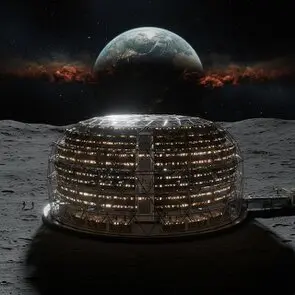
On the Moon, there reigned a silence as old as time itself. Inside the dome of Luna-Europa, one heard only the rhythmic, almost drowsy sighing of the oxygen generators. It was an artificial breathing that kept the four hundred souls alive, living up there like insects in a preserve jar. Arthur peered through the thick quartz glass. The Earth hung up there—or down there, depending on one’s perspective—like a dirty, half-extinguished sapphire. Once, it had been a jewel, bursting with light and motion. Now it looked dull. The glittering chains of the cities had faded, as if someone had draped a shroud over civilization.
"They aren't coming, Arthur," Sarah whispered behind him. She smelled of recycled water and the sterile chill of the station. "The deadline passed three days ago." Arthur didn't answer. He was thinking of fuel. It was a strange word for the end of the world. One always imagined the world would end with a bang, with fire and fury. But it was ending with a whisper, a slow stalling of engines, a final cough of the machinery. The Earth had run out of blood. The black gold that once bubbled from deserts and seas had run dry or lay buried beneath the rubble of wars.
II. The Geography of Want
The reports from the last supply ship, the Star-Hope, which had landed eight weeks ago, still burned in their minds. The crew had been pale, their eyes wide with panic. They spoke of a world where the wheels had stopped turning. China and Russia held the last functioning refineries like jealous dragons beneath their wings. Those without fuel had no voice. And the democracies of the West, once so proud of their logistics, now sat trapped in the snare of their own dependence. On the Moon, fuel meant everything. Without it, there was no heat against the two-week lunar night. Without it, there was no pressure regulation. The Moon was a beautiful grave if you didn't feed the machines.
"The EU has moved," Arthur finally said, his voice as raspy as moon dust. "The radio message from last week... before the long-range relays went silent. They called it 'Operation Phoenix'."
III. The Dragon’s Blood
Thousands of miles away, beneath the heavy, gray skies of Eastern Europe, the earth trembled. It was no natural quake. It was the march of the desperate. A special task force of EU states—a hastily assembled army of those who still had enough diesel for one last thrust—had crossed the Ukrainian border into Russian territory. It was not a war of ideologies. It was a war of pure existence. Arthur closed his eyes and imagined it the way Bradbury would have described it: He saw the tanks in the Ukrainian mud like iron beetles crawling laboriously through the mire. He saw the soldiers, young men from Paris, Berlin, and Kyiv, whose breath froze in the cold Russian air. They fought their way toward a refinery, a monstrous construct of pipes and chimneys pulsing like a mechanical heart in the borderlands. There, near Rostov, lay the prize. An ocean of kerosene and oil, guarded by Russian units who were equally desperate. It was a battle in the twilight. Rockets bloomed like deadly red flowers in the darkness. Metal shrieked against metal. The blood of the soldiers mingled with the oil seeping from shattered pipes—a black, sticky union of life and energy.
IV. The Game of Kings
"Why won't they just share?" Sarah asked. She sat on the floor, staring at her hands.
Arthur laughed dryly. "Because world politics has become a zero-sum game, Sarah. If Beijing shares the fuel, their own factories freeze. If Moscow gives it up, they lose their last leverage. Humanity is like a drowning man pushing his savior under the water just to breathe for one second longer."
He thought of the maps they had studied in history class. Borders drawn like scars across the continents. Now those scars had burst open. Ukraine had become the battlefield of last hope. A corridor of fire through which the EU fuel convoys were supposed to roll—if they could take the refineries. But the news had remained vague. "We have reached the facility," the last radio transmission had said. "Heavy losses. The Russians are threatening to self-destruct the tanks."
And then: silence.
V. The Waiting Void
Inside the moonbase, the lights in the corridors were dimmed to save energy. The darkness crept closer, a hungry animal patiently waiting for the batteries to die. The crew of the base consisted of four hundred people who now moved like ghosts through the shadows. They hardly spoke anymore. Every breath reminded them that oxygen was a gift from the machines, and the machines demanded their tribute.
"Do you think they made it?" Sarah asked. "Do you think the trucks are rolling west now? That the ships are rising into the sky to come get us?" Arthur looked at the Earth again. He saw a tiny, bright speck flare up in Eastern Europe. Was it an explosion? Or the triumphant light of a burning refinery? He didn't know. It could just as easily be the end of hope.
VI. The End of Summer
In the world of Ray Bradbury, there was always a certain poetry in decay. Arthur imagined the refinery as it stood now, wreathed in fire. A monument to greed and necessity. Perhaps even now they were filling the tanks of the great transporters. Perhaps they were fighting their way back through the snow to Europe, pursued by drones and the wrath of a dying giant. But up here, in the sterile glow of the lunar dome, it all felt infinitely far away. They were the children left behind in the attic while the house burned below.
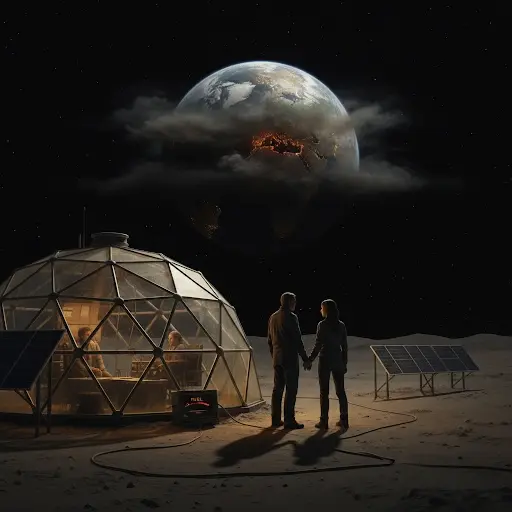
"We’ll know when the next morning comes," Arthur said. "Either we see the tail-light of a lander on the horizon... or we see nothing at all." He took Sarah's hand. It was cold. Outside, on the dusty surface of the Moon, the craters cast long, black shadows.
The Earth hung motionless in the firmament, a riddle of clouds and ash. In the base's tanks, the last of the reserves gurgled—a soft sound, like the ticking of a clock that is about to stop.
They waited. Not for a miracle, but for the fuel that had been pressed from the pain and the iron of the Earth. They waited for the return of warmth in a world that had forgotten how to share.
THE END